CASE STUDY
Dark staircase painted white, hall and landing, The Westlands, Newcastle-under-lyme
The short answer
This house in The Westlands, Newcastle-under-lyme had a dark mahogany-stained staircase that made the hall, stairs and landing feel gloomy. I prepared and primed the varnished woodwork, painted the staircase, panelling and trim white, and redecorated the walls and textured ceilings. The space is now bright and fresh, with the original doors and leaded glass kept as features.
BEFORE
AFTER
- LOCATION
- The Westlands, Newcastle-under-lyme
- Property
- House with original panelled doors and leaded glass
- Service
- Hall, stairs and landing, including staircase painting
- Level of work
- Full redecoration
- Duration
- 1 week
- Products
- Stain-blocking primer, white woodwork paint, wall and ceiling emulsion
What did the customer need?
The customer wanted their outdated hall, stairs and landing brightened up with a fresh, clean look. The dark stained staircase dominated the space and soaked up the light from the small windows. They wanted the staircase, spindles, newel posts and understairs panelling painted white. The walls, textured ceilings, coving, dado rails, skirtings and frames needed redecorating too, while the original panelled internal doors were kept in their dark wood finish.
What condition was it in?
The woodwork was sound, but the dark varnish looked tired and worn in places. The newel caps had pale patches where the finish had rubbed away from years of hands. The walls had a patchy pink finish, and the fan-pattern textured ceilings and coving were intact but dull. Nothing needed replacing, which made painting the right way to transform the space.
What preparation was needed?
The varnished staircase needed the most preparation, because paint will not stick to a shiny, sealed surface without it. This was a Full redecoration rather than a Refresh, because the whole look changed from dark wood to white and every surface needed full prep and priming.
1
Protected the stairs, landing and hall floor with dust sheets and carpet protector.
2
Cleaned and degreased the handrail, spindles and newels to remove years of hand grease.
3
Sanded all varnished woodwork to give the paint a key (a scuffed surface it can grip).
4
Filled dents and splits, then caulked the gaps where woodwork meets the walls.
5
Applied a stain-blocking primer to stop tannin bleed, where the dark stain seeps through light paint.
![Worn varnish on dark stained newel posts and ball caps on a landing in [Town]](https://irp.cdn-website.com/4d8d9257/dms3rep/multi/opt/03-before-worn-newel-caps-landing-1920w.jpg?jxl&v=jxl)
![Stairs protected with carpet protector before redecorating a hall and landing in [Town]](https://irp.cdn-website.com/4d8d9257/dms3rep/multi/opt/04-prep-stairs-protected-1920w.jpg?jxl&v=jxl)
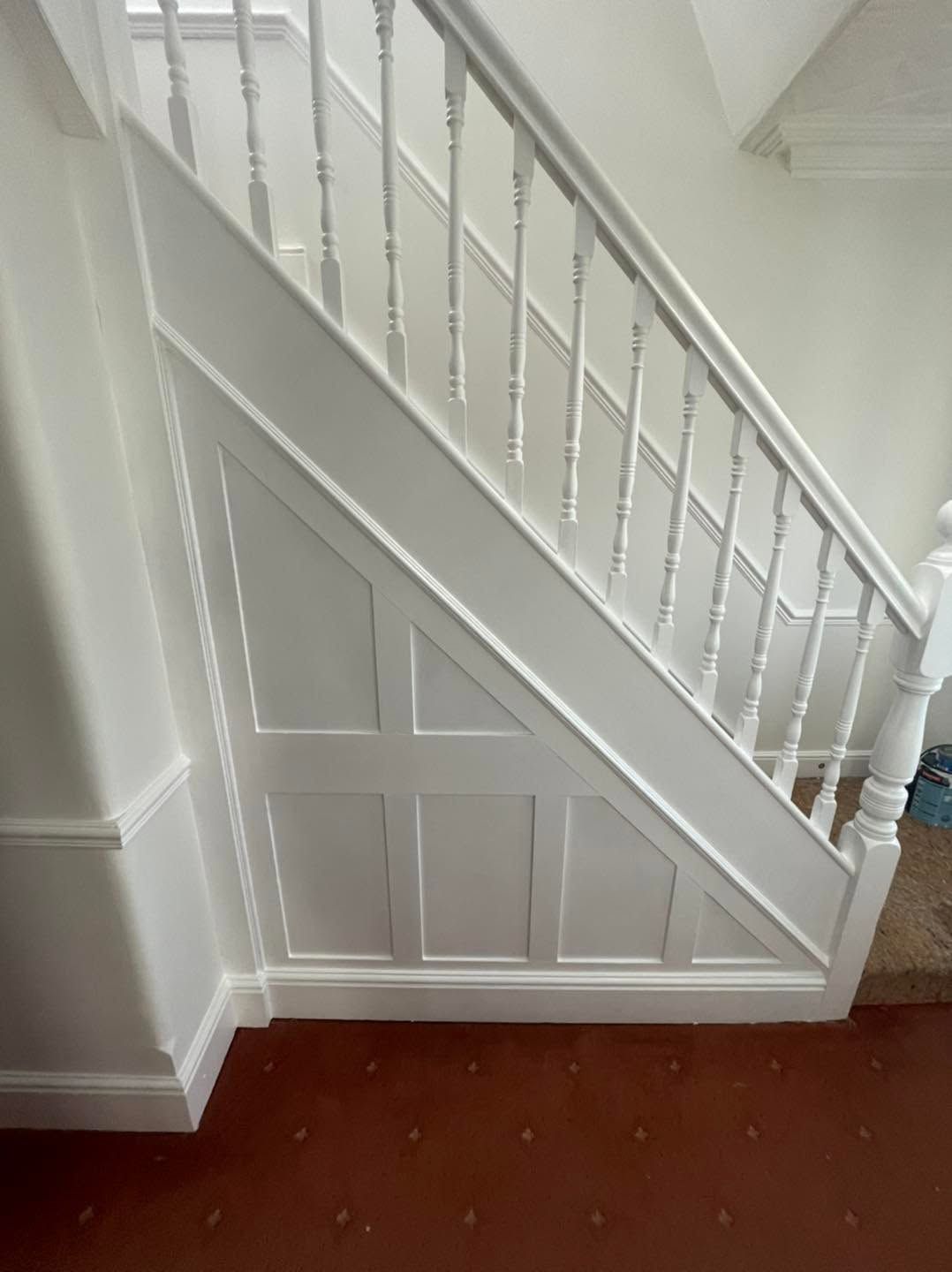
![White painted staircase, handrail and spindles from the side in a [Town] hallway](https://irp.cdn-website.com/4d8d9257/dms3rep/multi/opt/extra-09-after-staircase-side-1920w.jpg?jxl&v=jxl)
Which paints and materials were used?
I used a stain-blocking primer on the staircase to seal the old stain and give the topcoats a firm base. The woodwork, including the staircase, panelling, dado rails, skirtings and frames, was finished in white. The walls and textured ceilings were repainted in fresh emulsion. I painted the textured ceilings rather than sanding them, which is the safe approach with older textured coatings.
What was the result?
The hall, stairs and landing now feel bright, clean and welcoming. The white staircase has become the centrepiece of the house, and the understairs panelling now shows off its diagonal brace detail. The leaded glass, coving and textured ceilings stand out much more against the lighter walls. The dark original doors add a warm contrast and keep a sense of the house's age.
![Understairs panelling with diagonal brace detail painted white in a [Town] hallway](https://irp.cdn-website.com/4d8d9257/dms3rep/multi/opt/07-after-understairs-panelling-1920w.jpg?jxl&v=jxl)
Questions about this job
How long did the job take?
The job took 1 week from start to finish. Staircases take longer than they look, because every spindle needs cleaning, sanding, priming and several coats, and each coat needs time to dry before the next goes on.
Can you paint over a varnished staircase?
Yes, as long as it is prepared properly. The varnish needs cleaning, sanding to give it a key, and a good primer before any topcoats. Skip those steps and the paint is likely to peel or chip.
Will the dark stain show through white paint?
It can, if the wrong primer is used. Dark wood stains contain tannins that bleed through light paint and leave yellow or brown patches. A stain-blocking primer seals them in first.
Related links